Each axis is driven by linear motors with position feedback from linear encoders with 10 nanometer resolution. The technology of the air bearing slides eliminates air restrictor ports through the use of new technology. This technology provides ultra smooth motion that translates to ultra smooth surface finishes.
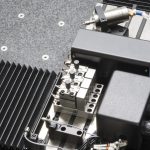
The lathe base is a 200 mm thick granite surface plate for accuracy and stability. The surface plate is mounted with vibration isolators on a welded steel frame. The complete machine and electronics are housed in a single cabinet.
The Z axis is mounted directly to the granite and carries the spindle. The X slide is also mounted on the granite and precisely positioned at 90o to the Z slide. This machine geometry assures the machining loads are well centered within the travel of the slides and that the spindle mounting is stiff and stable.
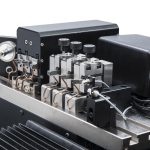
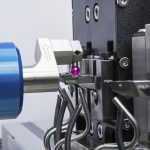
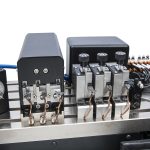
Multiple sets of tooling and a front surface gauging system are mounted on the X slide. The optional Oscillating Tool Technology (OTT) system can be added at the time of purchase or later to meet customer needs.
The Lathe spindle is a carefully balanced, air bearing high frequency unit with programmable speeds of 0 to 18,000 R.P.M. An AC motor drives this spindle. A DC motor with encoder feedback for the OTT option, provides torque at all speeds and the ability to synchronize with OTT tooling.
The Mill spindle is mounted on the X slide along with the standard roughing and finish tooling.This spindle is programmable from 25,000 to 160,000 RPM and can be used with both standard carbide or diamond tipped end mills.The collet holds 1/8” shank tools with a variety of diameters. Ultrahigh resolution of the C axis (Lathe spindle) allows interpolation between X, Z and C axes to mill the plan view of Intraocular lenses.
The part to be turned may be held in the collet or blocked to an arbor for turning. Special collet arrangements are also available upon request. It is recommended that all turning be done with blocked parts and second side turning must be done on an arbor. The roughing natural diamond tool is used to remove the bulk of the material. As the controlled waviness finishing tool removes only a minimal amount of material, its edge (and life) is preserved.
All cuts are made by Z or X motion, or by ZX interpolation. Spheric and aspheric lenses can be turned with input from .cdl files and data tables. In addition, with the OTT option, toric IOLs can be designed, loaded and turned in the same manner as spheres and aspheres by simply adding the second radii to the data table. Because of the fine resolution (.010 micron) the surfaces require little or no polishing, depending on the material used and the manufacturer’s process.
Typical intraocular lens surfaces are turned in approximately 60 seconds, depending on geometry and material used. Milling the haptic design is done in 45 to 60 seconds depending on the complexity of the design.
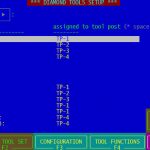
“Menu” type queries, on the color monitor screen, guide the user quickly through machine set-up, calibration, alignment and tool replacement. DAC Script Language (DSL), which employs a subset of RS-274D machine language, is a high level programming language that is easily understood by the user and is included in each lathe.
If all lens design parameters are known, the user simply enters the appropriate numbers by use of the keyboard. The machine will calculate variables, such as junction thickness, after the entry of the basic design factors. A display of a lens cross section aids the user in the design process by graphically presenting the actual design. The machine’s computer automatically converts the lens design specifications in the machine language program necessary to machine the desired part.
DAC software presents the laboratory with many, many options for the creation of lenses to meet the most demanding requirements. It can run as Windows or DOS based for easy interface with current DOS applications or other Windows-based lab equipment.
The DAC Digital Motion Control (DMC) system is at the “heart” of all DAC Lathes. It is housed in the on-board computer, mounted with the servo amplifiers, in the base of the machine behind interlocked doors for easy access. Each axis is driven by a linear servo motor with linear encoder feedback.
Auxiliary functions such as actuating lights, vacuums, air blow-offs, autoloaders, etc., are controlled by outputs from the programmable logic control.
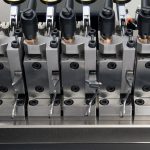
Both roughing and finishing tools are held in newly designed, micro-positioned holders that keep the tool parallel with spindle center. These robust tool holders are adjustable to accommodate a wide range of tool shank sizes.
The Oscillating Tool Technology (OTT) holds a diamond insert and is adjusted in the same vertical manner.
DAC International offers the industry’s most comprehensive lens manufacturing software — easy to use and easy to customize. Full maintenance and calibration capability is built into our software, as well as on-line editing
Full details on DAC International Software
Universal 1000 Autoloader
Mounted on the back of the machine base, this system takes up minimal additional floor space. It will hold up to 1000 buttons or 500 blocked parts, depending on the size of the blank or blocking arbor.
Special Air-Cooled Environment Chamber
For temperature-sensitive material, this thermostatically controlled chamber can be used with the Universal Loading systems. Temperature control can be kept between 10°C and 15°C (50–59°F).
AMCC Freeze Blocking System
The system includes all the items necessary for freeze blocking, including two stations, one for freezing the IOL blank to the blocking arbor and a second station for de-icing. A freezing fixture GFR-20-iol is mounted on the nose of the DAC lathe spindle to maintain the frozen part during machining.
| Slides: | Linear slides are DC linear servo motor with linear encoder feedback |
|
| X | Y | |
| Type: | Air-bearing | Air-bearing |
| Travel: | 304 mm (12″) | 152 mm (6″) |
| Resolution: | 10 nm (.4 micro-inches) | 10 nm (.4 micro-inches) |
| Accuracy (incremental): | ||
|
Center Thickness
|
±2.5 microns (0.0001″) | |
|
Diameter
|
±5 microns (0.0002″) | |
|
Radius of Curvature
|
±2.5 microns (0.0001″) | |
| Traverse rates: | 5 meters/min (200 IPM) | |
| Lathe spindle: | Air-bearingDC servo motor/encoder spindle 0 to 10,000 RPM with 0.036° resolution | |
| Mill spindle: | Air-bearingAC induction motor spindle 15,000 to 160,000 RPM | |
| Collets: | A wide variety of collets are available and supplied with the lathe. | |
| Power: | 208, 220, 230, 240 VAC, 1 phase, 50/60 Hz, 20 Amps |
| Air: | 5 CFM @ 80 PSIG (9 m3/hr. @ 5.6 kg./cm2) Clean, filtered, dry; supplied by user |
| Temperature: | 68 to 74 Degrees Fahrenheit |
| Vacuum: | User Furnished 3.2 cm (1.25″) Diameter Manifold |
| Floor space: | 1,219 mm x 1,270 mm x 1,778 mm (48″ x 50″ x 70″) |
| Weight: | Floor – 1,089 kg. (2,400 lbs.) |
| Shipping | Shipping – 1,271 kg. (2,800 lbs.) |